We carried out an ash dieback tree removal in Moffat at a working camping and caravanning site, clearing five hazardous and declining trees in all. The specialist job stood beside a protected badger sett: a mature ash of around sixteen metres that we dismantled in sections, under a NatureScot licence, with the sett and the surrounding habitat protected throughout.
The site asked us to deal with five trees that had become a safety concern across a busy camping and caravanning site. Three were ash affected by ash dieback at different stages, one was a dead hawthorn, and the last was a hawthorn that had split through the middle, a dangerous removal we handled in full control. Four of the five came down first. The fifth, the mature ash beside the badger sett, we deliberately left as the final phase, because the ground around it needed months of planning before a saw ever touched it.
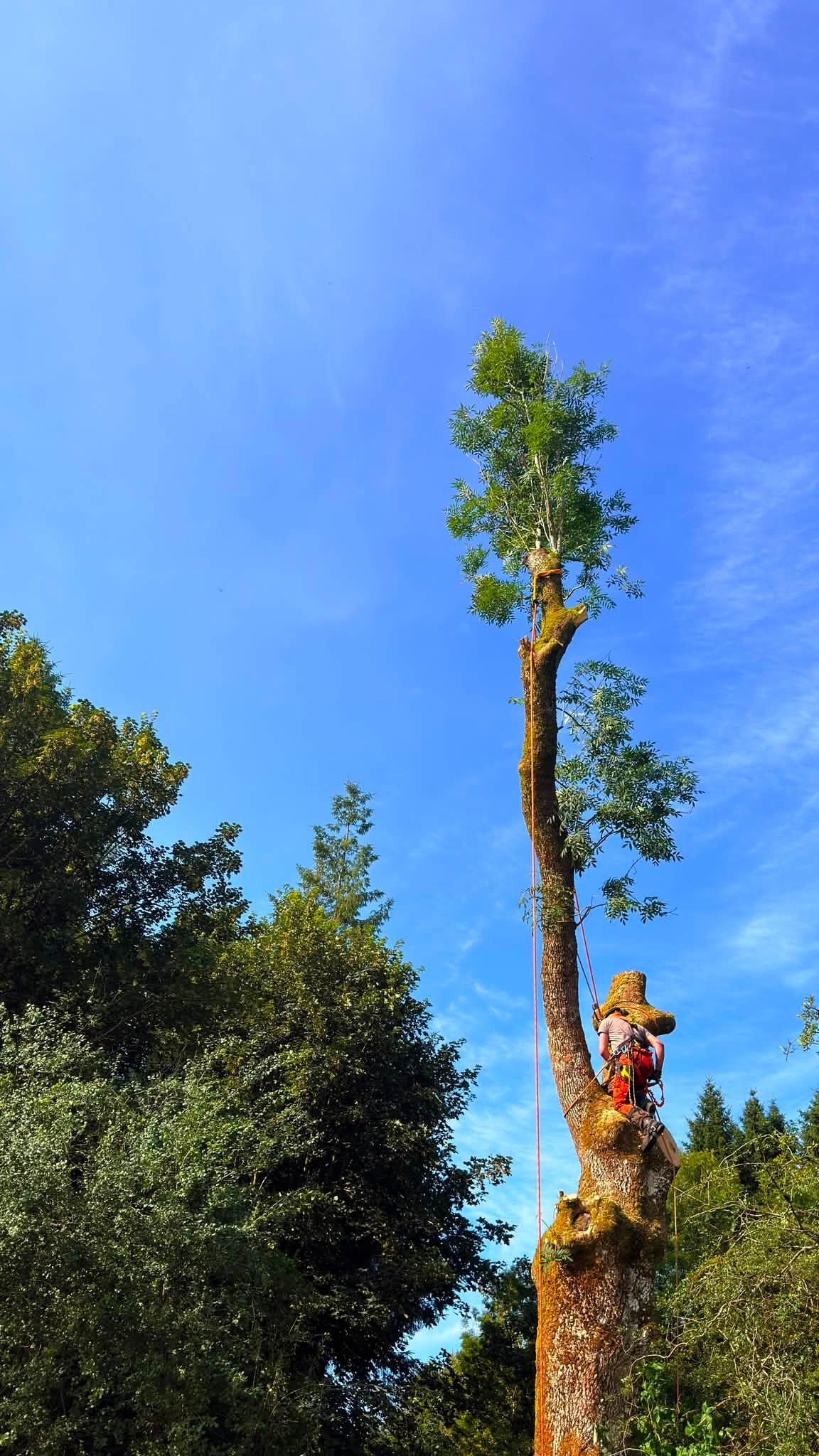
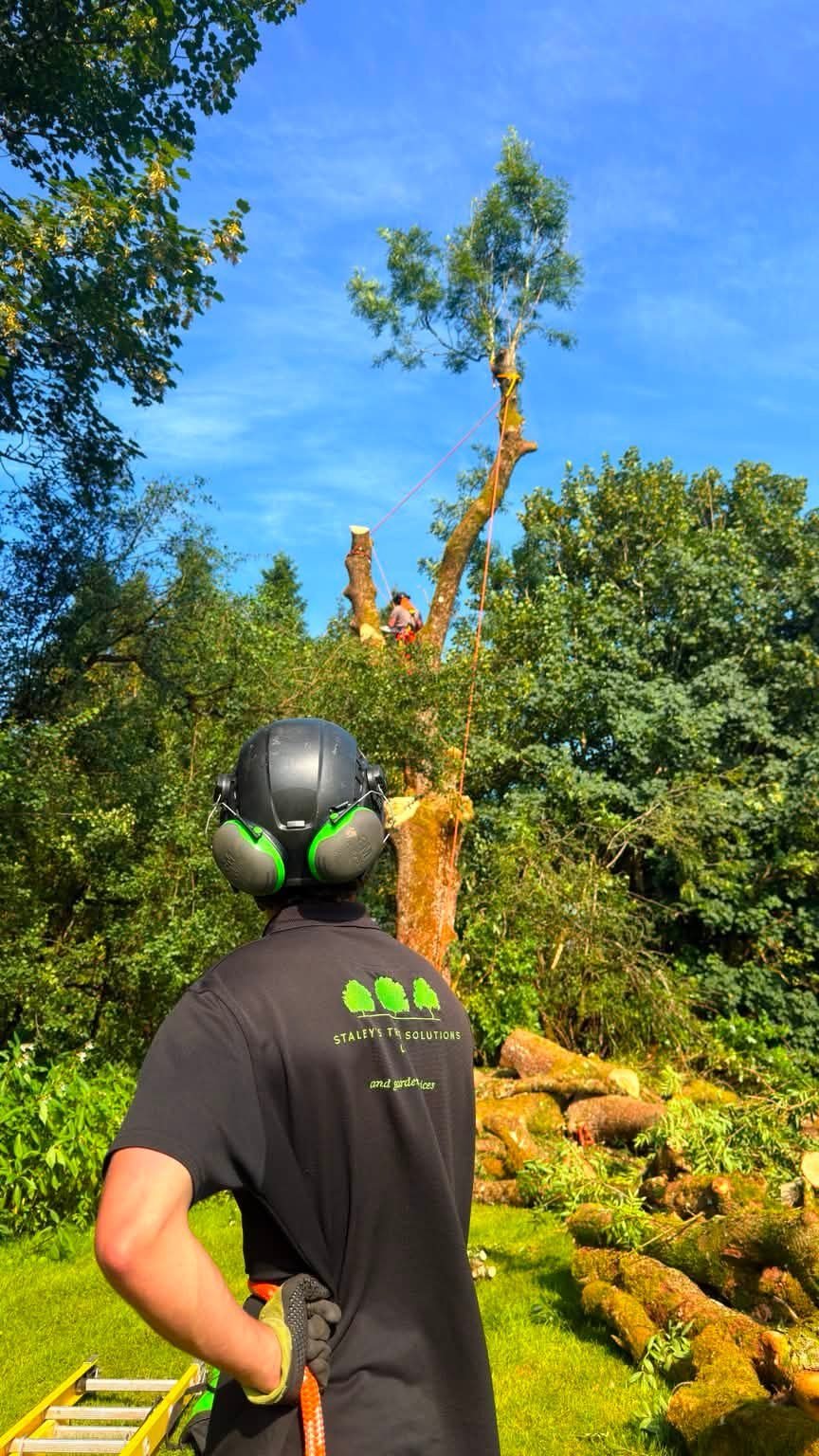
Our climber roped into the tall ash on the Moffat site, working the crown down from the top.
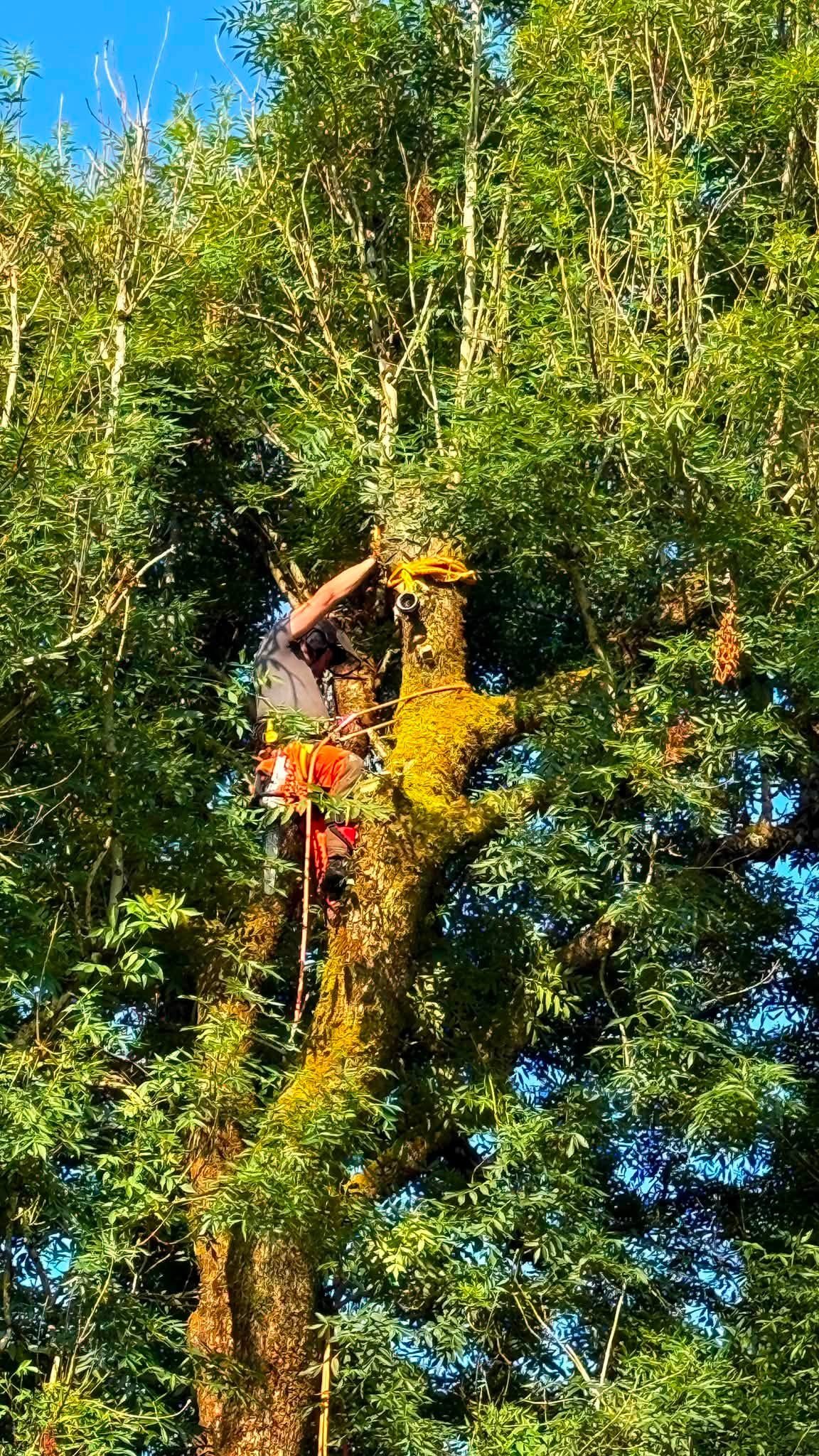
Working through the crown of one of the ash trees, section by section.
The disease
Ash dieback, and why these trees had to come down
Ash dieback is a fungal disease, Hymenoscyphus fraxineus, that Scottish Forestry describes as widely distributed throughout Scotland. It attacks the crown and the stem, and as a tree declines the disease can weaken the trunk and make the tree more prone to falling. With people and caravans beneath them, Scottish Forestry is clear that infected ash can pose a risk to public safety or property, which is why these three ash were taken down rather than left. We handle ash dieback removals like this across central Scotland and further afield.
Ecology first
Working around a protected badger sett
What made the feature ash a specialist job was not the tree, it was the ground beneath it. A substantial active badger sett sat immediately around its base. Badgers and their setts are protected by law: Scottish Badgers set out that it is an offence to interfere with a sett by damaging or destroying it, to obstruct an entrance, or to disturb a badger while it is occupying the sett, and that work which would otherwise break those rules has to be done under licence. So we brought in a registered ecologist, and the removal was carried out under a NatureScot licence and the ecological advice that came with it. Heavy machinery was kept out of an agreed twenty-metre zone around the sett, the rigging was planned to keep vibration and ground impact down, and no timber was stacked over the entrances or the runs. For a job of this size we also worked alongside CTM Tree Services, a contractor we collaborate with regularly, and coordinated with the ecologist, the site management and the local council so the tree work, the sett and the running of the campsite all fitted together.
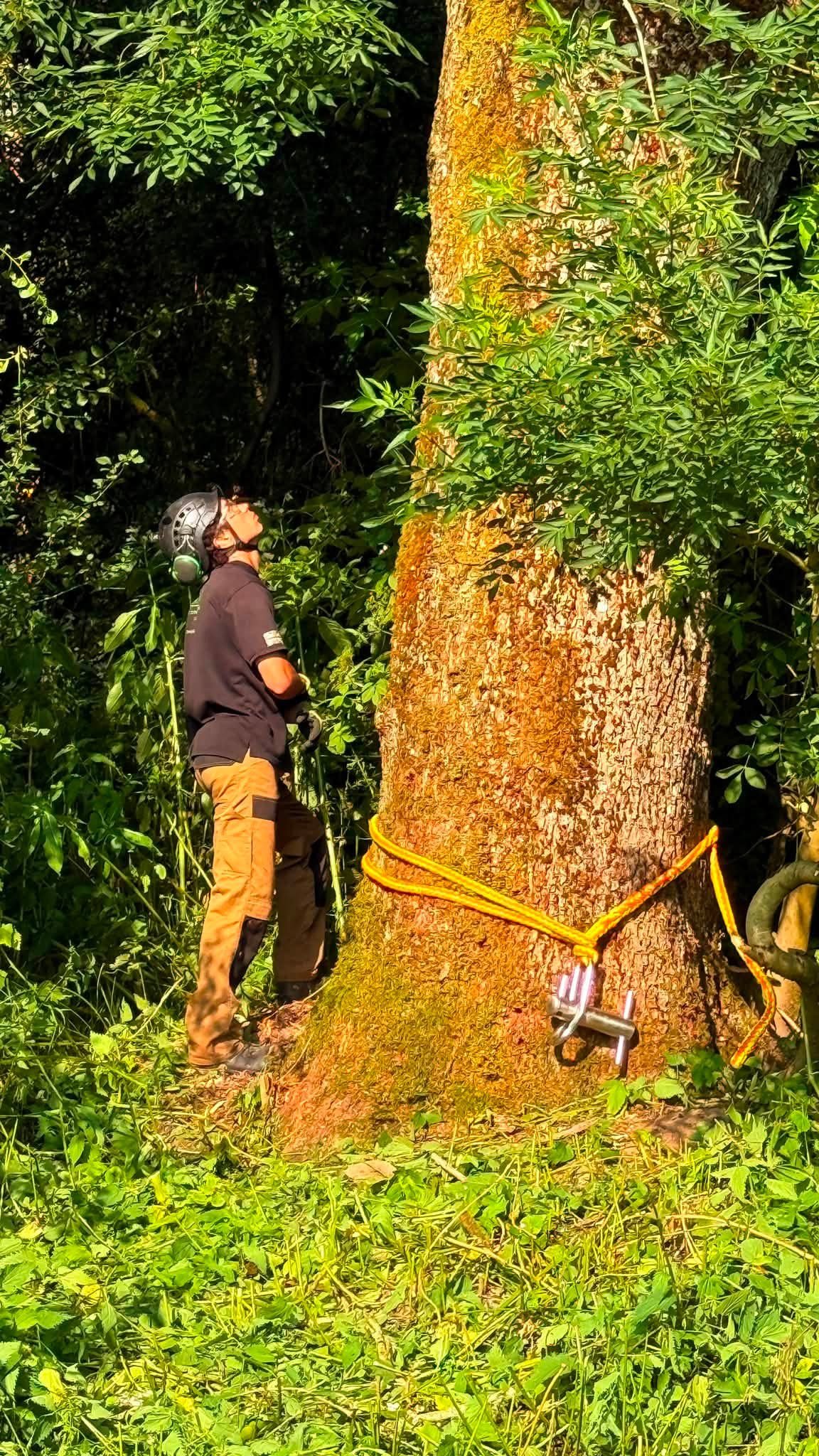
A rigging line and lowering device set at the base, so each section came down under control rather than dropping to the ground.
A groundworker keeping watch as the ash comes down in sections, with the cut timber stacked clear of the work.
The dismantle
Climbing and rigging a diseased ash
Ash dieback also changes how you climb. The timber can turn unreliable as the disease progresses, so the tree was checked before the climb and watched throughout, with back-up anchor points and no heavy shock-loading of weakened wood. Rather than letting large sections drop, the crew rigged and lowered them under control, which protected the ground, the sett and the people below in one go. Once the material was down, an extended-reach hydraulic grab pulled the timber and brash out while the tractor stayed outside the protected zone, so nothing heavy had to cross the sett.
The finish
A standing stem left for the sett, on a site that stayed open
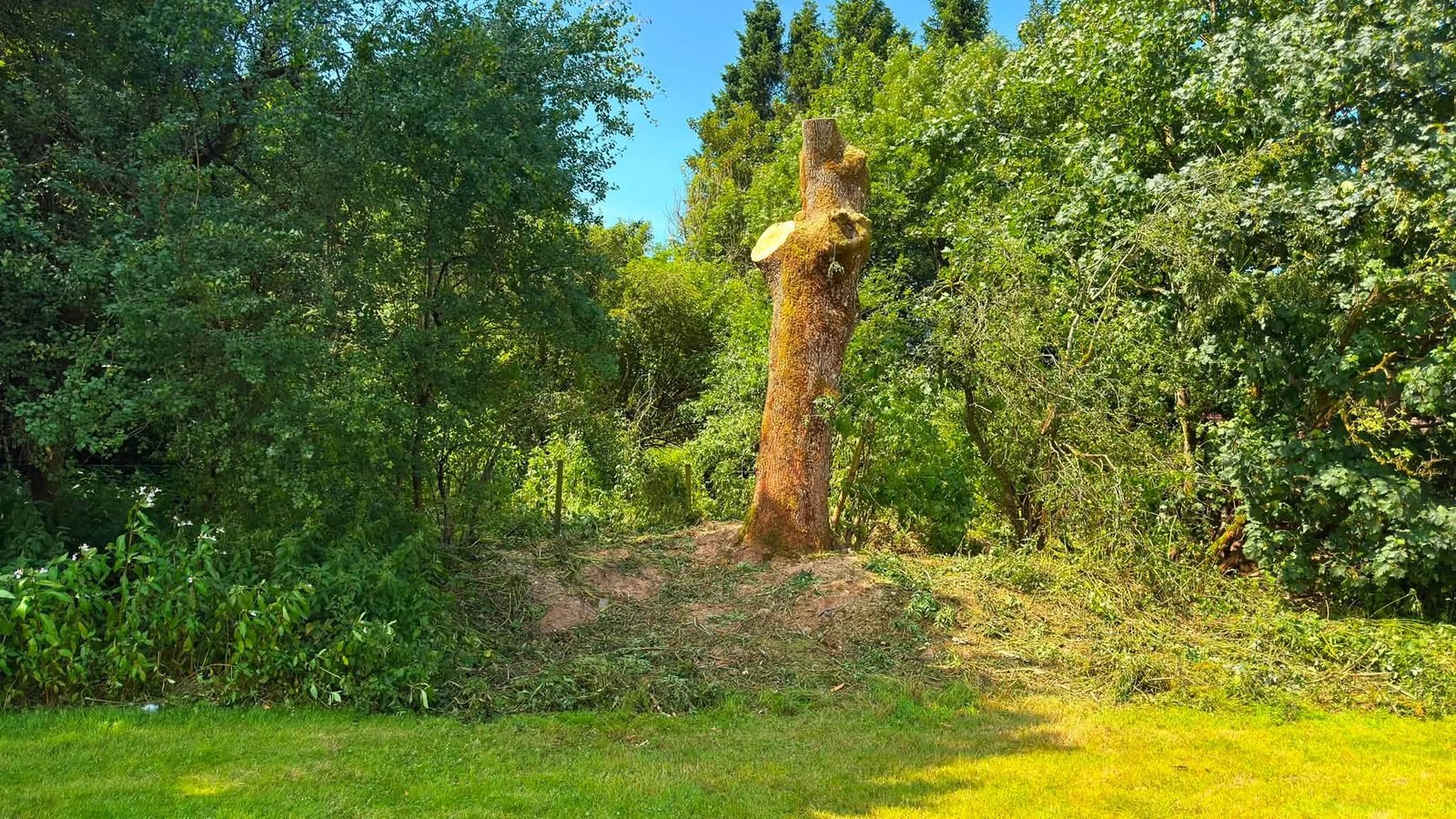
Instead of cutting the ash to ground level, about three metres of standing stem was left in place, in line with the ecological advice. A low stump would have invited people to climb or dig around a sensitive spot, and on a busy campsite that often means children, so the retained stem helps keep the sett secure and undisturbed. All the way through, the campsite stayed open: the pitches nearest the work were kept clear, the work zones were barriered and signed, and the public were kept out while the crew worked. The final ash came down over two days in the July heat with a team of five, and the timber and brash were cleared and sent for reuse or biomass where we could. In line with our replacement-planting policy in Scotland, new trees were planted once the work was done.
About three metres of standing stem left in place, in line with the ecological advice for the sett.
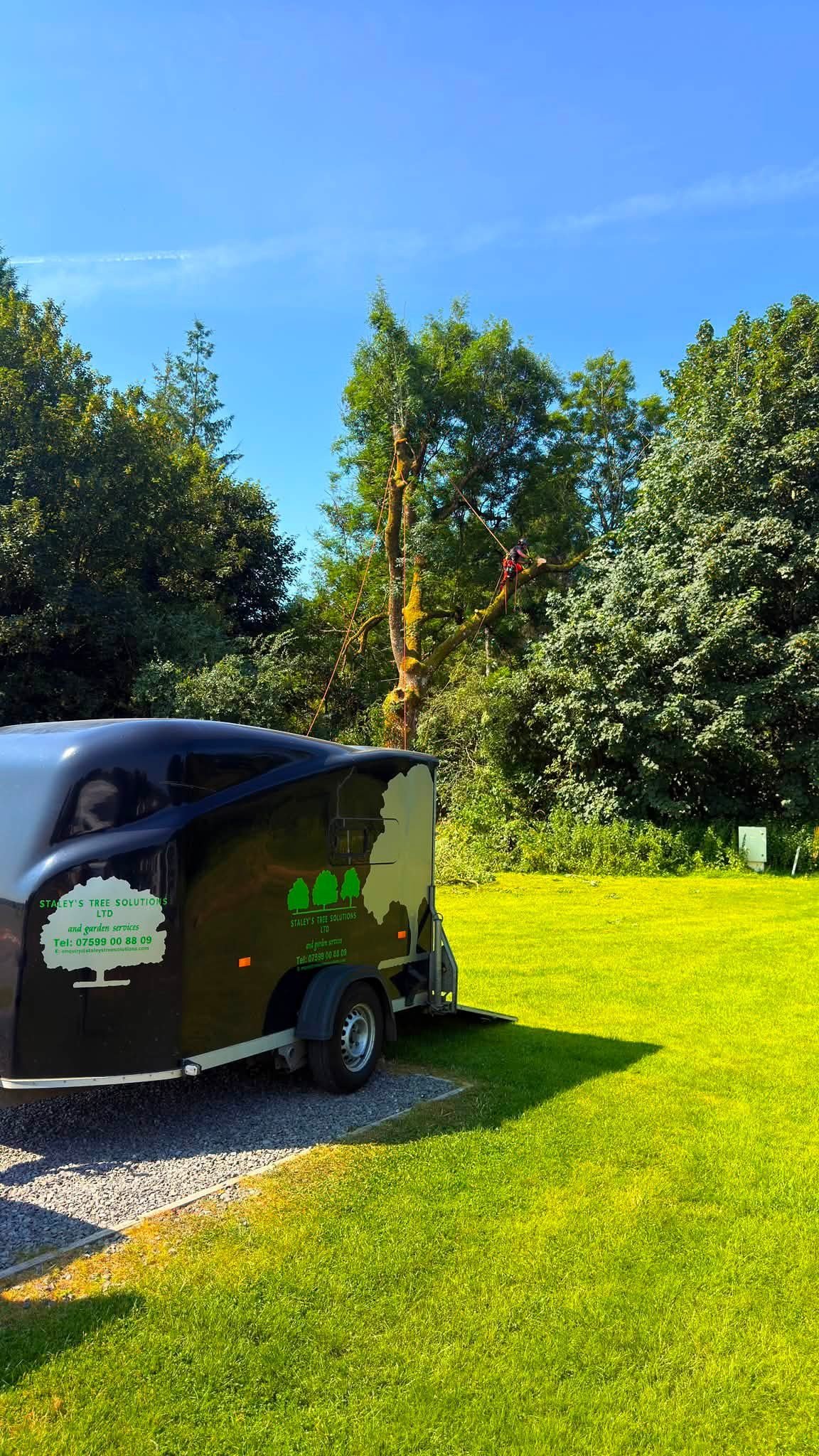
Our kit staged on the campsite grass, with one of the trees being worked behind.
Get in touch
Talk to us about a complex or protected-site removal
If you have a tree that is more than a straight fell, near a protected species, on a working site, or a hazard that has to come down, that is the kind of job we plan for. Staleys Tree Solutions is based in the Stirling and central Scotland area and travels for complex and commercial removals like this Moffat one, with £5M public liability insurance on every job. For a free, no-pressure look at what your trees need, get in touch or call 07599 008809.
Got a tree that needs seeing to? Let's have a look.